

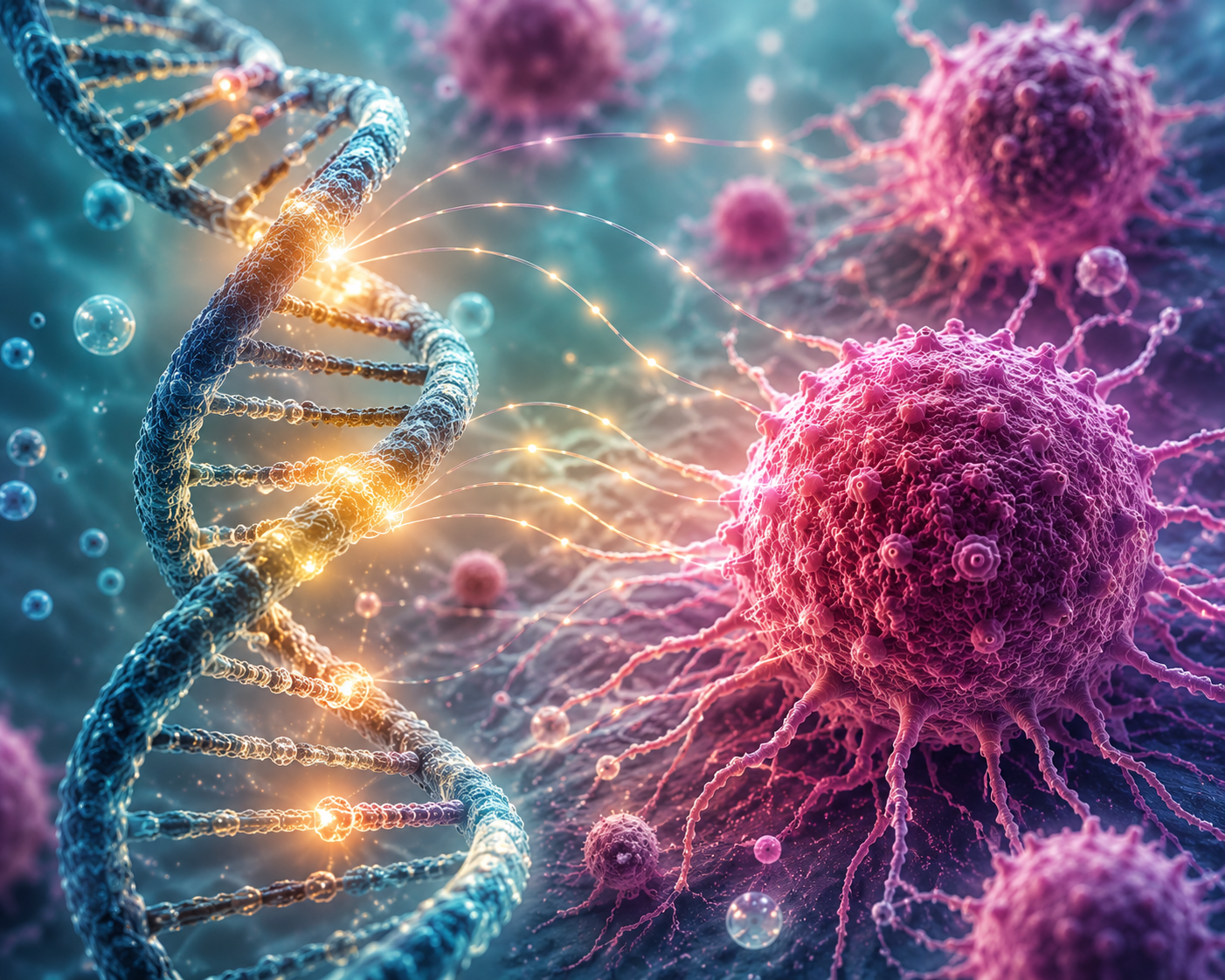
For decades, cancer research has focused primarily on mutations within genes—the sections of DNA that provide instructions for making proteins. However, these genes make up only about 2% of the human genome. The remaining 98%, once dismissed as "junk DNA," is now emerging as one of the most important areas of cancer research.
A new study published in Nature Genetics sheds light on how small regions of non-coding DNA known as enhancers may influence breast cancer development. Rather than producing proteins themselves, enhancers act like genetic switches, helping control when, where, and how strongly genes are activated. Researchers found that alterations in these regulatory regions can disrupt entire networks of cancer-related genes, potentially contributing to disease development and progression.
Investigating the Hidden Genome
To better understand how breast cancer-associated enhancers function, researchers used single-cell CRISPR interference (CRISPRi) technology to systematically examine 3,513 enhancer regions previously linked to breast cancer risk. The study analyzed more than 500,000 individual breast cancer cells, allowing scientists to observe how silencing specific enhancers affected gene activity across the genome.
Unlike many previous studies that focused only on nearby gene targets, this approach enabled researchers to investigate both direct and indirect effects, revealing complex communication networks between enhancers and cancer-related genes located throughout the genome.
Key Findings
The study revealed that breast cancer-associated enhancers do not function independently. Instead, they form interconnected regulatory networks that influence multiple genes simultaneously.
Researchers found that some enhancers directly regulated well-known cancer-associated genes, including CITED4, TNFSF10, and TSPAN1. The individual enhancers could influence the activity of multiple cancer-related genes and multiple enhancers sometimes converged on the same cancer-associated gene. Several distinct enhancers indirectly affected TP53, one of the most important tumor suppressor genes in human cancer. These findings suggest that enhancer regions function more like complex communication hubs than simple on/off switches.
Why This Matters
Large genetic studies known as genome-wide association studies (GWAS) have identified thousands of DNA variants associated with breast cancer risk. However, many of these variants are located within non-coding regions of the genome, making it difficult to understand how they contribute to disease. This research provides some of the clearest evidence yet that non-coding DNA can influence cancer through extensive gene regulatory networks. Rather than affecting a single gene, changes within enhancer regions may alter the activity of entire biological pathways involved in cancer growth and progression. The findings also demonstrate the power of modern tools such as CRISPR-based screening and single-cell sequencing, which allow researchers to examine genetic regulation with unprecedented precision.
Looking Ahead
While additional research is needed to understand how these regulatory networks operate in patients, the study highlights an important shift in cancer biology. Scientists are increasingly recognizing that understanding cancer requires looking beyond genes alone and examining the broader regulatory systems that control them.
As technologies continue to improve, these hidden DNA switches may reveal new ways to identify cancer risk, understand tumor behavior, and potentially develop more targeted therapies in the future.
The Takeaway
Breast cancer is influenced not only by mutations within genes but also by changes in the regulatory DNA that controls them. This study shows that non-coding regions of the genome act as interconnected genetic switches capable of influencing entire networks of cancer-related genes. By uncovering how these hidden regulatory elements function, researchers are gaining a deeper understanding of the biological mechanisms that drive breast cancer and discovering new avenues for future research and treatment.
 Top
Top