

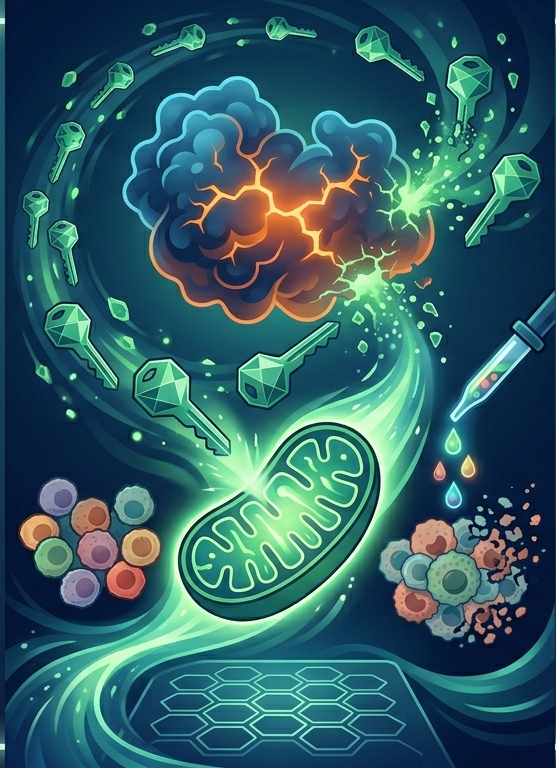
By CancerQuest News
For decades, the KRAS protein was considered the "Death Star" of cancer biology: a powerful driver of tumor growth that was seemingly impossible to target with drugs. While recent years brought the first FDA-approved KRAS inhibitors, many patients still face a major hurdle—the cancer often finds a way to become resistant to the treatment. Now, researchers at UC San Francisco (UCSF) have unveiled a breakthrough that could change the game. Using a sophisticated new modeling platform called GENEVA, scientists have identified exactly how KRAS-mutant cancers dodge treatment and, more importantly, how to stop them.
The Problem: Tumor "Mosaicism"
One reason cancer is so hard to treat is that a single tumor isn't made of identical cells. It is a "mosaic" of different genetic backgrounds. A drug might kill 90% of the cells, but the remaining 10%—the ones with a specific genetic "shield"—survive and multiply.
Previously, testing how drugs interact with all these variations required thousands of separate, expensive experiments.
The Solution: The GENEVA Platform
The research team, led by Hani Goodarzi, PhD, and colleagues at UCSF, developed GENEVA (Genetic Evaluation of Variability).
This platform allows scientists to:
Pool Diversity: Combine many different patient-derived cancer cell lines into a single "mini-tumor" model.
Track Responses: Use advanced genetic sequencing to see exactly which cells live and which die when exposed to a drug.
Identify Targets: Pinpoint the specific biological pathways that make a cell resistant or sensitive to treatment.
Key Discoveries
Using GENEVA to study KRAS-G12C inhibitors (used in lung and colorectal cancers), the team made two vital discoveries:
1. Mitochondrial Power: They found that "mitochondrial activation" is a key driver of cell death. Essentially, if the drug can successfully kickstart the cell's power plants (mitochondria), the cancer cell is much more likely to die.
2. The Resistance Shield: They identified "epithelial-to-mesenchymal transition" (EMT), a process where cancer cells change their shape and properties—as a primary way tumors hide from KRAS drugs.
Why This Matters for Patients
This research isn't just about understanding resistance; it’s about overcoming it. By knowing that EMT protects cancer cells, doctors can look toward combination therapies, using a KRAS inhibitor alongside a second drug that prevents the cancer from "shapeshifting." "This platform bridges the gap between the lab and the clinic," the researchers noted. By simulating the complexity of a real human tumor in a dish, GENEVA allows scientists to find the right drug combinations faster than ever before.
 Top
Top