

Newsroom

Many anti-cancer therapies work by using the body's own pathways to trigger programmed cell death (apoptosis). Many cancers, however, become resistant to anti-cancer drugs by modifying downstream events. Researchers of an article presented in Cancer Gene Therapy, however, have created a genetically… more

During development, the intestinal tract needs to grow asymmetrically. If it cannot, an infant is born with an intestinal birth defect. While studying this phenomenon, researchers at North Carolina State University discovered the compound heterotaxin, which not only causes intestinal birth defects… more

Oncogenes are genes that have undergone a mutation that allows cells to survive and proliferate beyond the normal restrictions the body has in place. MYC and RAS are two oncogenes common in many types of cancer, but these genes alone are usually not enough to promote the development of cancer. This… more

Melanoma is the most aggressive form of skin cancer and causes the most deaths. It is especially important to catch the cancer early to ensure effective treatment. Tissue biopsies, which involve the removal of unusual moles and other skin abnormalities, are today's standard method of detection. Out… more

In order to get good information on who gets cancer and to advance research, it is important that accurate and timely records be kept by physicians. This action ensures accurate dates of diagnosis and referrals, and it is integral for separating accurate diagnoses from false ones. A study in the… more

The use of information stored in our genes is tightly controlled. The active use of a gene (called gene expression) is involves the production of RNA based on the DNA code (transcription) into messenger RNA (mRNA). This mRNA is then 'read' and used to produce proteins via a four-step… more

A phase II study of advanced cancer patients showed that administration of delta-9-tetrahydrocannabinol (THC) lead to improvements in the patients' senses of smell and taste. The treated patients also had increased appetites and reported feeling more relaxed. THC is the active component… more

Epgenetic changes are alterations of DNA and the DNA packaging proteins (histones) that can alter the way our genes are used without directly changing the DNA sequence itself. A common epigenetic change is the addition of a small chemical group (methyl group or CH3) to cytosine bases (the C in our… more

A Dutch study of 562 melanoma skin cancer survivors showed that women are more significantly affected by having had the disease. Women reported more extreme impacts, both positive and negative. They were also more likely to be worried about exposure to UV radiation and were more likely… more

The human T-cell lymphotropic virus 1 (HTLV-1) is a human retrovirus that causes leukemia. New research has helped to define exactly how the virus is able to take over normal cells. The virus produces a protein (p30) that binds with several key cell regulators (ATM and REGγ). ATM… more

A study of 59 breast cancer survivors showed that they were more likely suffer falls than women who had not had breast cancer. The researchers tested the women and found that they had altered balance and some changes to their visual perception. The differences are likely to be due to… more
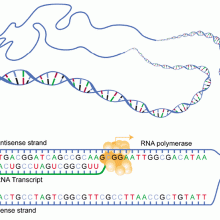
Genetic damage is critical in the development of cancer. A new review suggests that there is more than one way that damaged DNA can cause problems. The first is when altered DNA is 'read' (transcribed) correctly but actually encodes the wrong thing. It would be as if the word 'CAT… more
The spread (metastasis) of cancer to distant locations is responsible for about 9 out of 10 cancer deaths. It is very important that we understand how and why a cancer spreads to particular locations. New research shows that tumors can prepare a site for metastasizing cells before the… more

Cancer treatments can cause fertility problems, a particular concern for young patients. A new study with monkeys (Rhesus macaques) showed that pre-treatment of females with chemicals that prevent cell death can prevent the infertility caused by radiation. The monkeys were given sphingosine-1… more
Because viruses are able to enter and kill cells, they are being actively examined for their potential to treat cancer. Viruses that grow in cancer cells but do not harm normal cells have been developed and several are being tested in clinical trials against a variety of cancers. … more

There is good evidence that, at least in some cancer types, not all cancer cells are equally able to divide and form tumors. The select cells that acts as the driving force in the development of cancer are known as cancer stem cells (CSC). Evidence suggests CSC are responsible for… more

Exposure to radiation therapy for head/neck cancers has been associated with a significantly increased risk for hearing loss. A study that compared 141 patients with 141 people who were not treated for head/neck cancer found that the patients were more likely to have hearing loss. Those… more
Ovarian cancer (OC) is the most lethal gynecologic cancer. Much of the death seen is due to the direct spread of organs in the abdomen. One of the changes that make cancer cells more likely to spread (metastasize) is a change known as the epithelial-to-mesenchymal transition (EMT… more

A study of about 800 men showed that treatment with as little as 6 months of anti-androgen therapy was able to reduce the spread of prostate cancer and increase survival of treated patients. Three months of treatment also showed some impact but was not shown to be beneficial in terms of… more

Bone metastasis occurs in many different types of cancer and can lead to pain and bone weakness. New research has determined that a signaling pathway known as the 'Notch' pathway is involved in activating bone-destroying cells (osteoclasts) and causing the production of proteins that enhance… more
 Top
Top